My Back Hurts...Should I Just Stretch It?
Raise your hand if you've ever said one of these...
"I must have slept wrong."
"I'm getting old."
"My back has just always hurt."
Or my personal favorite...
"I probably just need to stretch more."
The truth?
Back pain has become so common that we've almost accepted it as a normal part of life. We joke about throwing our backs out while picking up a sock or sneezing too hard. Somewhere along the way, we started believing that living with back pain was just part of getting older.
Here's the good news...it doesn't have to be.
Your Back Might Not Be the Problem
This surprises a lot of people.
Most back pain isn't caused because your back is "bad." More often than not, your back is working overtime because other parts of your body aren't doing their job.
Think of it this way...
If your core isn't providing stability, your spine has to pick up the slack.
If your glutes aren't doing their share of the work, your back jumps in to help.
If your posture is less than ideal after spending eight hours at a desk, guess who's taking the extra load?
Yep...your back.
Your spine is incredibly strong, but it was never designed to do all the work by itself.
This is Why Pilates Works
One of the things I love most about Pilates is that we don't just chase symptoms.
Instead of asking, "How do we make your back stop hurting?" we ask, "Why is your back working so hard in the first place?"
Pilates focuses on strengthening what Joseph Pilates called your Powerhouse. Today, we think of it as your deep core, glutes, pelvic floor, diaphragm, and the muscles that support your spine.
When those muscles begin working together, your spine finally gets the support it's been asking for.
It's a little like carrying groceries.
If one person is carrying every bag, they're going to get tired pretty quickly. But if everyone grabs a few bags, suddenly the job becomes much easier.
That's exactly what we're trying to do for your spine.
There Are Three Things You Can't Skip
If your goal is to reduce back pain and move more comfortably, there are three things I consider non-negotiable.
1. Work with Someone Who Knows What They're Doing
Google is wonderful.
YouTube has its place.
But neither can watch how you're moving.
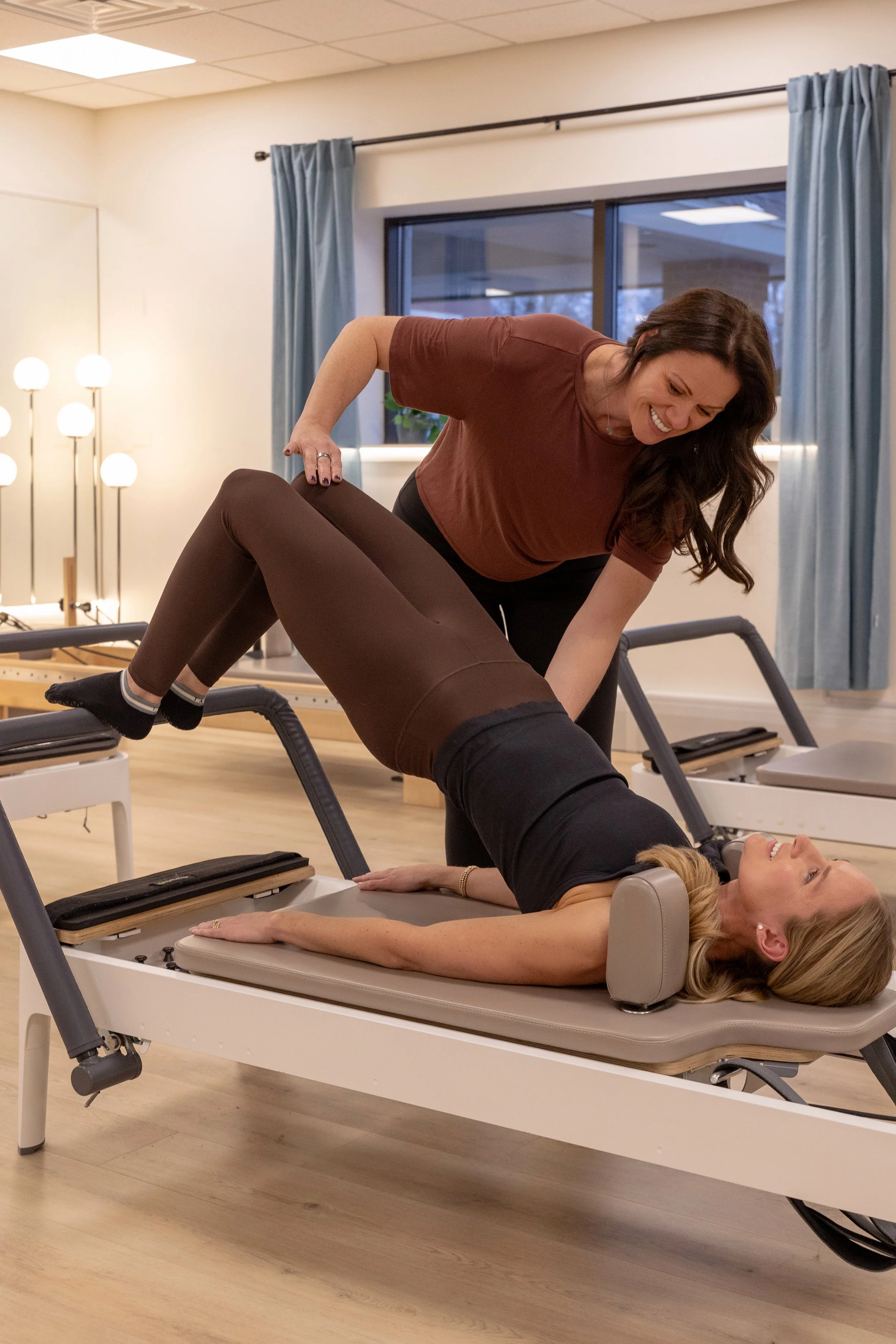
A certified Pilates instructor can identify movement patterns, modify exercises to meet your needs, and make sure you're building strength safely. Every back is different, which means every program should be different too.
2. Use the Equipment
When most people think of Pilates, they picture a mat.
While mat Pilates is fantastic, the equipment opens up an entirely different world.
The Reformer, Chair, Cadillac, Spine Corrector, Ladder Barrel...each piece of equipment allows us to support, challenge, and strengthen your body in different ways. One apparatus might help you find better alignment, while another helps build strength without putting unnecessary stress on your spine.
Think of it as having an entire toolbox instead of just one screwdriver.
3. Be Consistent
I wish I could tell you one Pilates class would fix years of back pain.
If only.
The truth is, your body adapts over time, and it takes time to create lasting change. The good news is that every class builds on the last one. Consistency doesn't mean you have to live in the studio. It simply means showing up often enough for your body to learn a new way of moving.
Your spine will thank you for it.
Movement is Medicine
One of the biggest myths about back pain is that you should stop moving until it feels better.
In many cases, the opposite is true.
Research continues to show that appropriate movement is one of the best things you can do for many types of back pain. That's why Pilates can be such an effective tool. We meet your body where it is today and gradually build the strength, mobility, and confidence it needs to move better tomorrow.
So Here's Your Challenge...
The next time your back starts talking to you, instead of immediately blaming your back, ask yourself a different question.
"What else might not be doing its job?"
Pay attention to your posture. Notice if you're using your breath. Think about whether your core is helping support the movement or if your back is doing all the heavy lifting.
Sometimes your back isn't asking for another stretch.
Sometimes it's asking for a little backup.
That's exactly what Pilates is designed to provide.