
Raise your hand if you've ever woken up, turned your head to look at the alarm clock, and gone "Nope. Not today."
Or gotten out of the car after a long drive feeling like someone parked a bowling ball on the back of your neck.
Or reached back to rub that one spot between your shoulder blades… the one that always has a knot in it.
You're not imagining it. And you're definitely not alone.
Here's the thing: your head weighs about 10–12 pounds. When it's stacked right on top of your spine, your body handles that weight beautifully. But for every inch your head drifts forward, the muscles in the back of your neck and upper back have to work harder and harder to hold it up. It's often compared to carrying a bowling ball with your arms tucked in versus holding it straight out in front of you. Same ball. Very different workload.
And most of us spend our entire day holding it straight out in front of us. 😆
So… what is forward head carriage?
It's exactly what it sounds like. Your head slides forward of your shoulders, your shoulders round in, and your upper back curves forward to follow.
You've probably heard it called "tech neck." Phones, laptops, steering wheels, the kitchen counter, folding laundry… we live our lives looking down and forward.
What happens underneath is basically a tug-of-war that the front of your body is winning.
In the front, your pectoralis major and minor (your chest muscles) get short and tight from being rounded all day. In the back, your rhomboids and middle and lower trapezius, the muscles that are supposed to draw your shoulder blades back and down, get stretched out and tired. And sitting right at the base of your skull, the little suboccipitals and your upper traps are working overtime to keep your eyes level with the horizon.
That knot between your shoulder blades? Often that's an upper back muscle that's been pulled long and held there all day, waving a little white flag.
That tension headache that creeps up the back of your head by 3pm? Many clients find it lives right in that same overworked neck-and-shoulder team.
It's not just your phone (your car and your pillow are in on it)
This is the part nobody talks about.
Your car. Most of our cars have those cozy bucket seats that curve you into a C-shape. Then the headrest, which is angled forward in a lot of newer cars, gives your head a little nudge further forward. You're driving to work, to school pickup, to the studio… in a perfect forward-head position.
A few things to try:
Add lumbar support. A small lumbar pillow or a rolled-up hand towel behind your low back helps your pelvis and spine stack upright, and when the bottom of the spine is supported, the head has a much easier time finding its way back on top.
Bring your seat back more upright. Reclining a lot actually encourages your head to reach forward toward the windshield.
Check your headrest. In some cars it can be adjusted or tilted. Some people even turn theirs around so it sits flatter instead of pushing the head forward. Please check your car's owner's manual first. Your headrest is a safety feature designed to protect your neck in a collision, so only change it if your manufacturer says that's okay.
Use your rearview mirror as a posture coach. Set it while you're sitting tall. If you start to slump, you won't be able to see out of it… and you'll know. 😉
Your pillow. If you sleep on your back with a big, fluffy pillow (or two!) under your head, you're essentially doing tech neck all night long, with your chin pushed toward your chest for 7–8 hours.
The fix is surprisingly simple: pull your pillow down just a little so it slides under your neck, filling that natural curve, rather than propping up the back of your head. Your neck gets supported and your head gets to rest in neutral. Side sleepers, you want your pillow to fill the space between your ear and your shoulder so your head isn't tipping up or down.
Small change. Big difference in how you feel at 6am.
Try it right now
Yes, right where you're sitting.
Sit tall and feel your sit bones under you.
Without tipping your chin up or down, gently slide your head straight back, like closing a drawer. (Yes, you'll get a little double chin. Nobody's watching. 😂)
Now turn your palms forward and reach your arms down and slightly behind you, letting your collarbones widen.
Take a breath here and feel the space across the front of your chest and the gentle work between your shoulder blades.
That's it. That's the whole goal: back of the neck long, chest open, upper back awake.
Why stretching alone won't get you there
Here's something I teach every single one of my trainees, and it's one of my favorite things about how the body works.
You can't fully contract a muscle if the opposite muscle is too tight to let you get there.
Your muscles work in pairs. When one side contracts, the other side has to let go. So if your chest is locked up tight, your upper back muscles can try all they want… they simply can't pull your shoulders back into place. The front won't release enough to let them.
Which is why we don't just stretch the chest. And we don't just strengthen the back. In Classical Pilates, we do both at the same time: we open the front while we strengthen the back, so the two sides finally start working as a team instead of fighting each other.
What this looks like in the studio
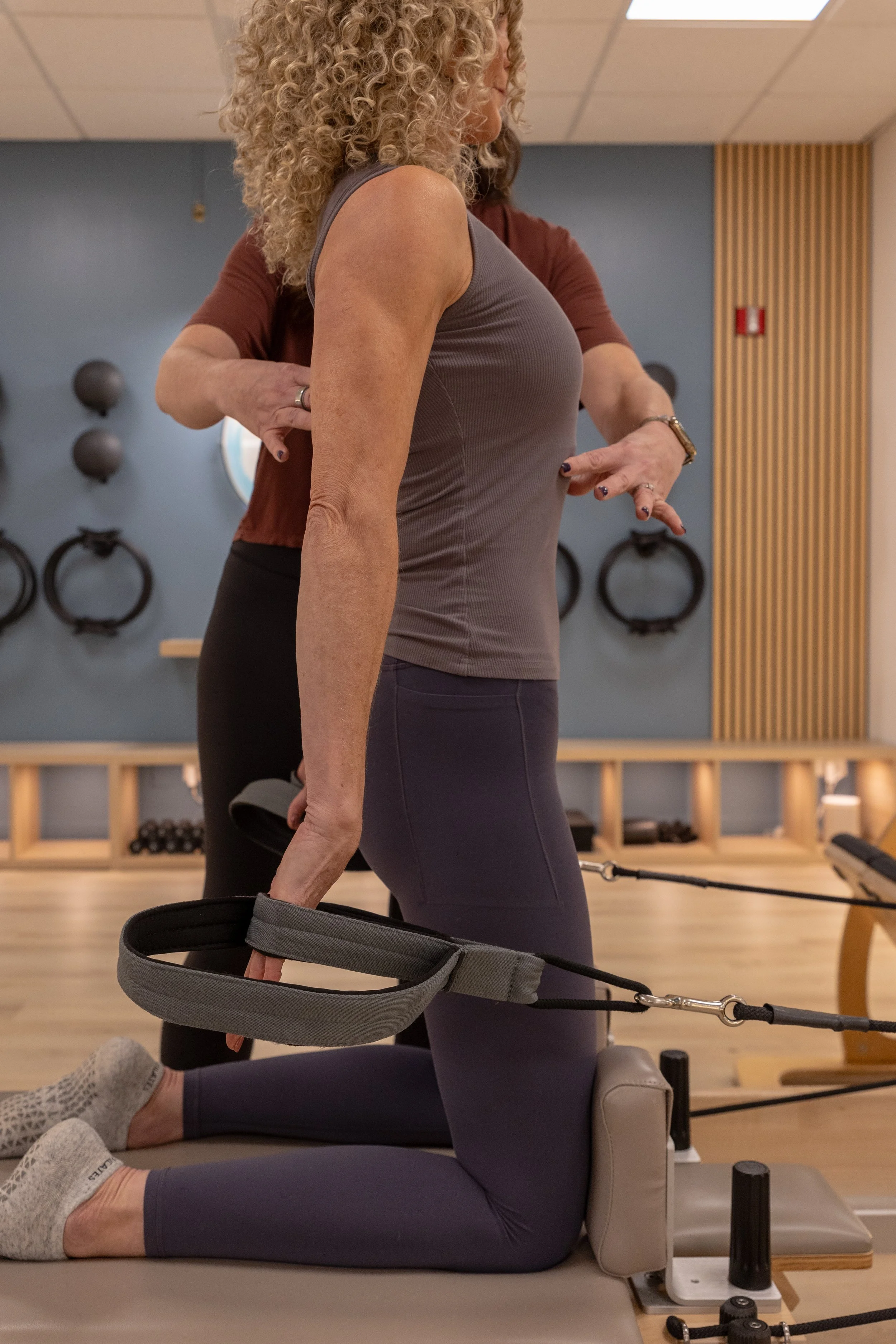
Take Chest Expansion on the Reformer. You're kneeling tall, holding the straps, and you press your arms back behind you while you keep your torso still and your head long. The straps ask your upper back to work, while your chest gets a beautiful, active opening across the front.
Then there's Pulling Straps on the Long Box. You're lying face down, drawing the straps back toward your hips, lifting your chest just slightly. It's one of the best exercises out there for the muscles between your shoulder blades. And you're doing it with your head floating in line with your spine, with no phone in sight.
And on the Mat, Swan teaches your upper back to extend and your chest to open… the exact opposite of the shape you've been in all day.
This is what Joseph Pilates was after: a body that's balanced front to back, from the inside out. Not just a stretch here and a strengthener there, but the whole system working together.
Why this matters (beyond looking cute)
When your head sits where it's meant to, the muscles in your neck and upper back don't have to grip all day. Many of our clients tell us they notice fewer of those afternoon tension headaches, fewer "I slept wrong" mornings, and a lot less of that nagging knot between the shoulder blades.
You may even notice you stand a little taller. (Your instructors definitely will.)
A quick note: if you have numbness, tingling, or headaches that are frequent or severe, please check in with your doctor or physical therapist. We love working alongside them.
So here’s your challenge…
This week, pick one spot: your pillow, your car, or your desk. Make one small change. Pull the pillow down. Roll up a towel for your low back. Reset that rearview mirror.
Then come see us and let your instructor know which one you picked. We'll make sure your upper back gets some love in class.
Your neck will thank you. And I'll see you in the studio! 💛